
A modern automotive brake pad is a composite component engineered to convert kinetic energy into heat through friction while staying structurally stable under extreme braking loads. Understanding its construction is the first step to cutting it cleanly.
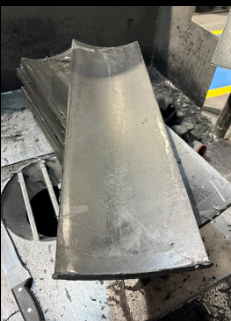
· Steel backing plate — typically cold-rolled low-carbon steel (DC04 or similar), 3–6 mm thick. It provides structural support and the mounting surface for the caliper.
· Friction material (friction lining) — 8–15 mm thick, bonded to the backing plate under heat and pressure. This is the layer that wears against the brake disc.
[ Image: cross-section of a brake pad — steel backing plate + friction lining ]
alt: cross-section of a brake pad showing steel backing plate and friction material
The friction lining is a complex composite. Its exact recipe varies by pad type, but it almost always combines a binder, reinforcements, fillers, and friction modifiers:
|
Pad type |
Key ingredients |
Cutting implication |
|
Semi-metallic |
Steel wool / iron powder fibers, graphite, friction modifiers, phenolic resin binder |
Highly abrasive; steel fibers accelerate diamond wear and demand a sharp, durable bond |
|
Ceramic |
Ceramic fibers (e.g. potassium titanate), non-steel fillers, copper-free formulations, phenolic resin |
Hard and brittle; cuts cleanly but chips easily if the rim is segmented or aggressive |
|
Low-metallic / NAO |
Non-asbestos organic fibers, rubber, glass, mineral fillers, ≤20% metal |
Softer, gummy; tends to load the blade if not enough clearance or cooling |
|
Aramid-fiber reinforced |
Kevlar pulp, mineral fiber, rubber particles |
Tough, stringy when cut; benefits from a continuous rim to avoid fiber pull-out |
Brake pads sold in regulated markets must meet performance and homologation standards — ECE R90 in Europe, FMVSS 135 in the United States, and GB 5763 in China. These standards govern friction performance and wear, which is why manufacturers cut test samples and production pads to precise dimensions and cannot afford burnt or delaminated edges that would distort lab results.
Cutting a brake pad is not like cutting tile or concrete. Three properties make it uniquely challenging for a saw blade:
1. Extreme abrasiveness. Steel fibers, ceramic particles, and hard mineral fillers in the friction material act like a grinding medium. They erode the bond matrix and dislodge diamond grit faster than typical stone.
2. Heat sensitivity of the binder. The phenolic resin binder that holds the friction material together begins to thermally degrade at roughly 250–300°C. Excess cutting heat carbonizes the resin, causing discoloration, delamination, and a weakened edge that will fail friction testing.
3. Composite structure. The transition from soft friction material to hard steel backing plate within one cut means the blade must handle two very different materials in a single pass — without chipping the friction lining or burning through the steel.
Key takeaway
The ideal brake-pad blade must be sharp enough to cut steel fibers, tough enough to resist abrasion, and cool-running enough to protect the phenolic binder — all while producing a chip-free, dimensionally accurate edge.
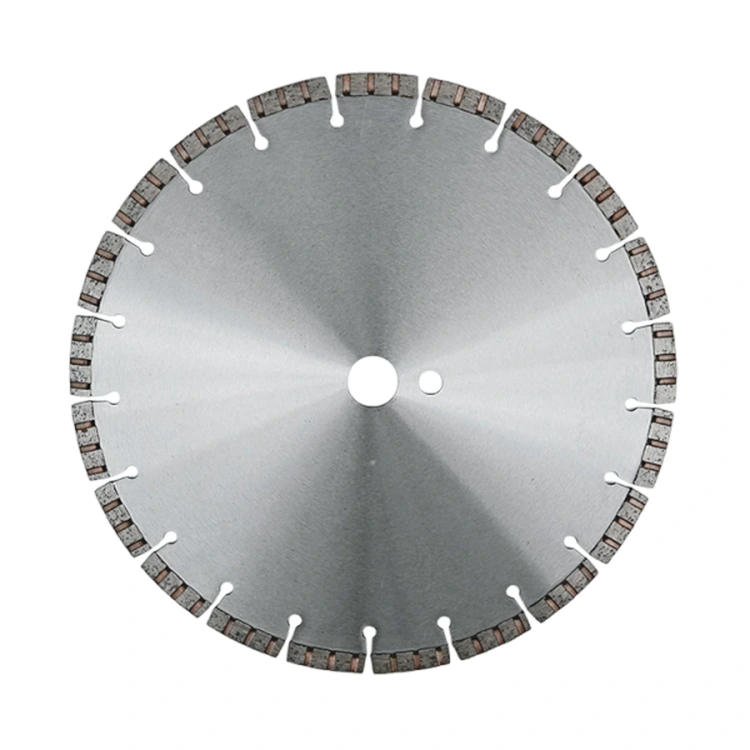
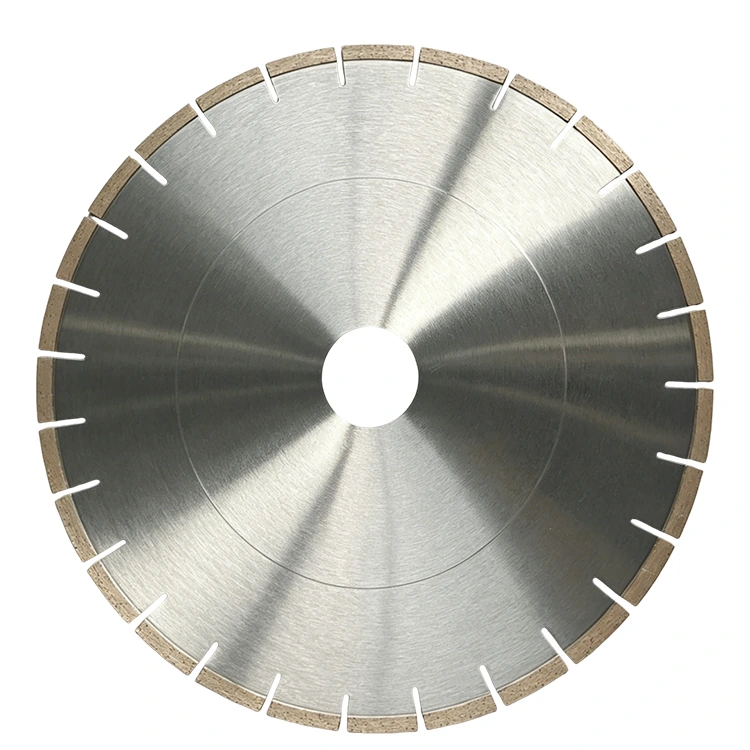
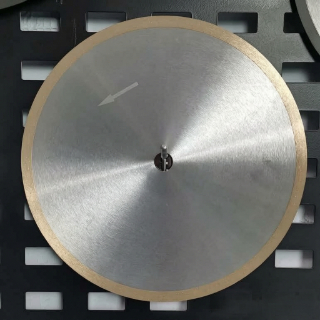
A welded continuous-rim blade uses a steel core with a diamond segment welded around its full circumference — with no gaps between segments (hence "toothless" or "continuous"). The weld is made by either laser welding or high-frequency (induction) welding.
· Multi-layer diamond in a metal bond. The segment is a sintered mix of diamond grit held in a metal matrix (cobalt, bronze, or iron-based). As the surface grit wears, new diamond is exposed — giving the blade a long, self-sharpening service life.
· Continuous rim = even pressure. Because there are no segment gaps, cutting pressure is distributed evenly around the circumference. This is what prevents the impact-fracture and chipping that segmented rims cause on brittle friction material.
· Strong segment-to-core bond. Laser welding creates a metallurgical bond that survives high side loads and intermittent contact with the steel backing plate without segment loss.
Batch and production cutting of friction material; quality-control sampling where edge integrity affects test results; any application where blade life per dollar matters more than maximum cutting speed.
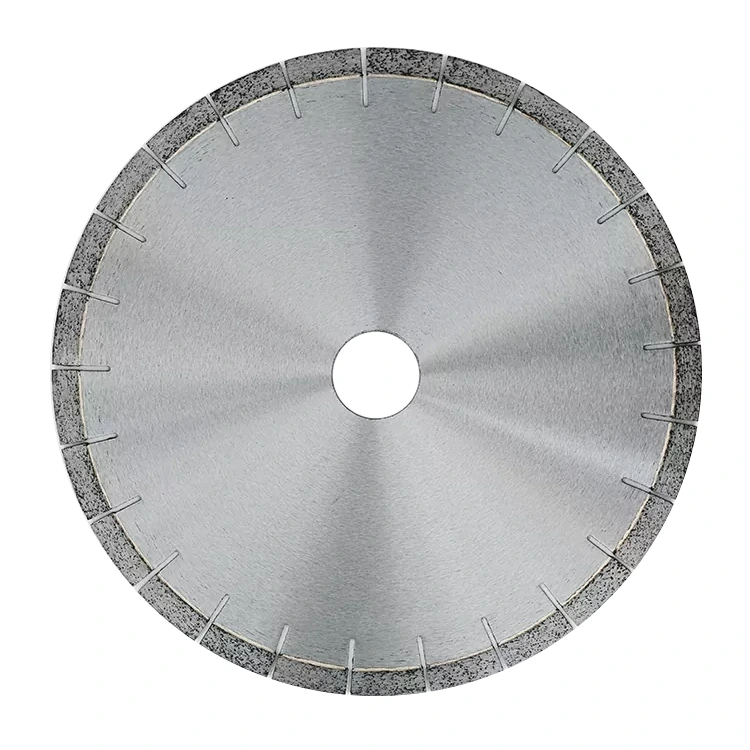
An electroplated (nickel-bonded) blade holds diamond grit on the core by electroplating a single layer of nickel over the diamond particles. The diamond sits exposed on the surface, not embedded in a sintered matrix.
· Single-layer, fully exposed diamond. Close to 100% of the diamond protrudes from the nickel bond, so the blade is extremely sharp out of the box and cuts with very low force.
· Thin kerf. Electroplated blades can be made very thin (often 1.0–1.5 mm), which means a narrow saw line, less material loss, and less heat — useful for precision trimming and contour work.
· No self-sharpening. Once the exposed diamond wears or pulls out, cutting performance drops sharply. There is no new layer beneath — so service life is short by design.
Precision trimming, contour or profile cutting, thin steel backing plates, prototype and small-batch work, and any job where sharpness and accuracy matter more than total blade life.
|
Property |
Welded continuous-rim (toothless) |
Electroplated (nickel-bonded) |
|
Diamond layer |
Multi-layer, sintered in metal bond |
Single layer, exposed in nickel |
|
Rim type |
Continuous, no segments (toothless) |
Continuous, very thin kerf |
|
Core bond |
Laser or high-frequency weld |
Electroplated nickel |
|
Initial sharpness |
Medium |
Very high |
|
Service life |
Long (self-sharpening, multi-layer) |
Short (single layer) |
|
Edge quality on friction material |
Excellent — minimal chipping |
Excellent — very clean, low force |
|
Cutting speed |
Medium, steady |
Fast (sharp, low resistance) |
|
Kerf width |
Wider (~2.5–3.5 mm) |
Narrow (~1.0–1.5 mm) |
|
Heat management |
Wet cutting recommended |
Wet or dry; dissipates heat fast |
|
Steel backing plate |
Handles intermittent steel contact well |
Wears quickly on steel |
|
Cost per cut (high volume) |
Low — long life amortizes cost |
High — frequent replacement |
|
Cost per cut (small batch) |
Higher upfront cost |
Low — cheap blade, sharp results |
|
Best use case |
Production & QC sampling |
Precision, contour, prototype |
Rule of thumb
If you are cutting hundreds of pads a day, the welded continuous-rim blade wins on cost-per-cut and edge consistency. If you are cutting a few pads with tight tolerances or curved profiles, the electroplated blade wins on sharpness and kerf.
Match the blade to your production reality, not to the material alone:
1. Volume first. Production lines → welded continuous-rim. Lab/QC and prototype → electroplated.
2. Friction material type. Semi-metallic and ceramic pads reward the durability of a welded blade. NAO and aramid pads can load a continuous rim — ensure adequate cooling and consider a slightly more open bond.
3. Always cut wet. Water suppresses the heat that destroys phenolic resin and it traps the fine dust (which can contain steel, ceramic, and historic copper residues) that no operator should breathe.
4. Size the blade to the machine. 115–230 mm blades suit bench-top cutoff saws; 300–400 mm blades suit continuous production lines.
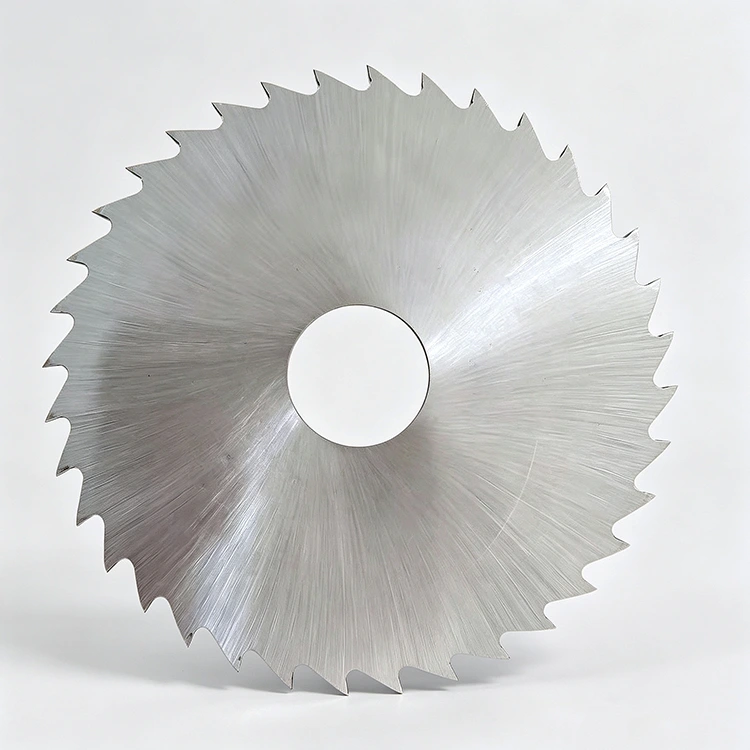
5. For the steel backing plate alone, a dedicated metal-cutting segmented or abrasive blade is often more economical than consuming diamond life on pure steel — cut the friction lining with diamond, the plate with the right tool for the job.
Yes. The friction material — steel fibers, ceramic particles, and mineral fillers — is abrasive but fully cuttable with diamond. The steel backing plate is best handled with a continuous-rim or segmented metal-cutting blade. For production volume, a welded continuous-rim diamond blade gives the best balance of life and edge quality.
For batch production of friction material, a welded continuous-rim (toothless) blade lasts longer and cuts cleaner with less chipping. For precision trimming, contour cuts, or thin steel backing plates in small batches, an electroplated blade is sharper, thinner, and more accurate but has a shorter service life.
A continuous (toothless) rim distributes cutting pressure evenly, which minimizes chipping and delamination of the friction material. Segmented rims create impact at each segment boundary that can fracture the binder matrix and cause edge breakage.
Wet cutting is strongly recommended. Brake friction material uses a phenolic resin binder that degrades above roughly 300°C. Water cooling prevents the heat that would burn, carbonize, or delaminate the friction lining — and it extends blade life while suppressing harmful dust.
Use wet cutting, match the blade bond to the friction material hardness, avoid forcing the blade through the cut, dress the diamond exposure regularly, and store blades flat to prevent distortion. For high-volume lines, laser-welded blades with multi-layer diamond segments outlast single-layer electroplated blades many times over.