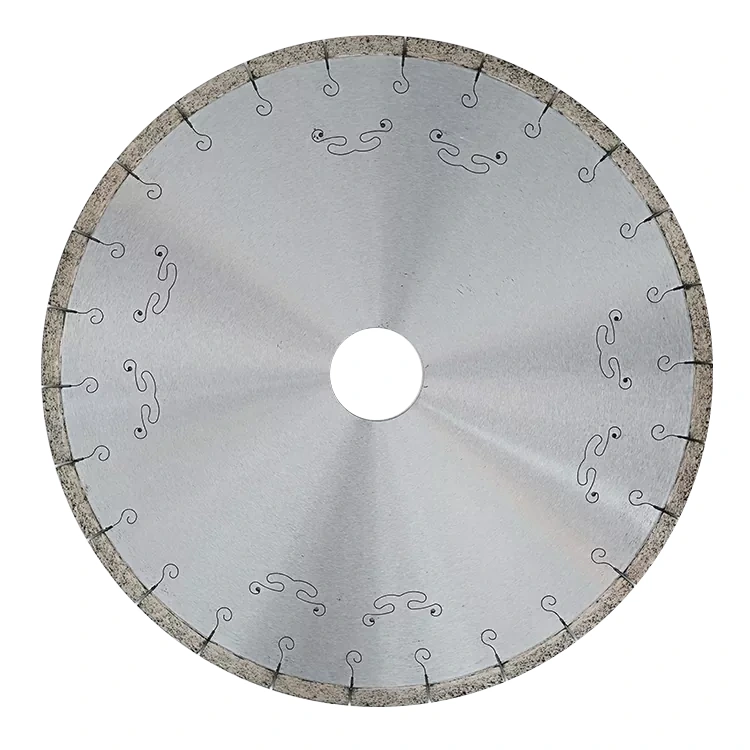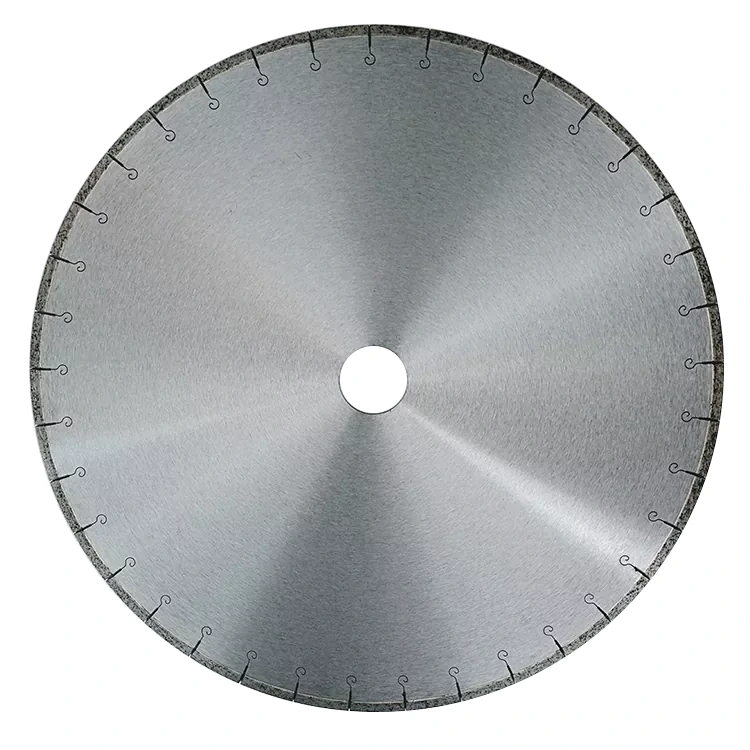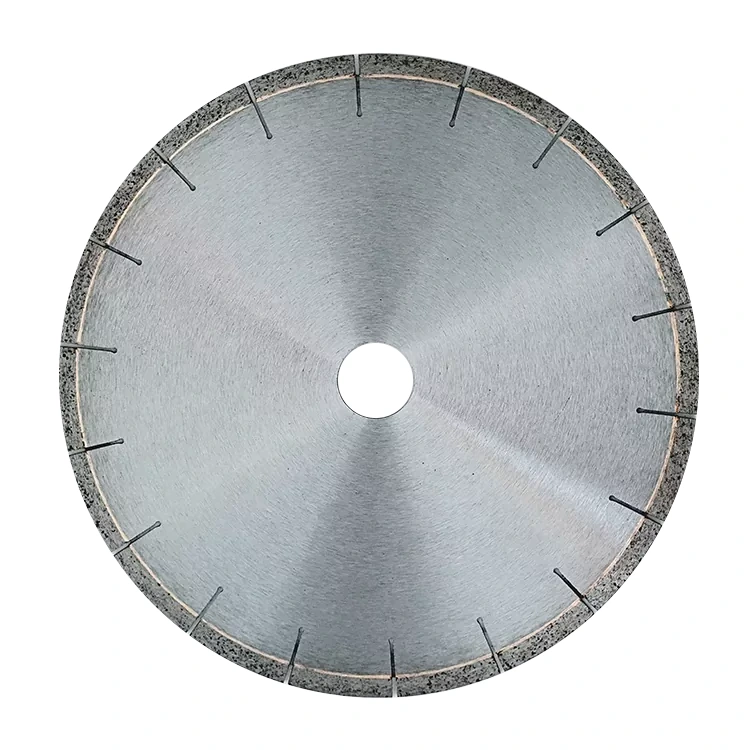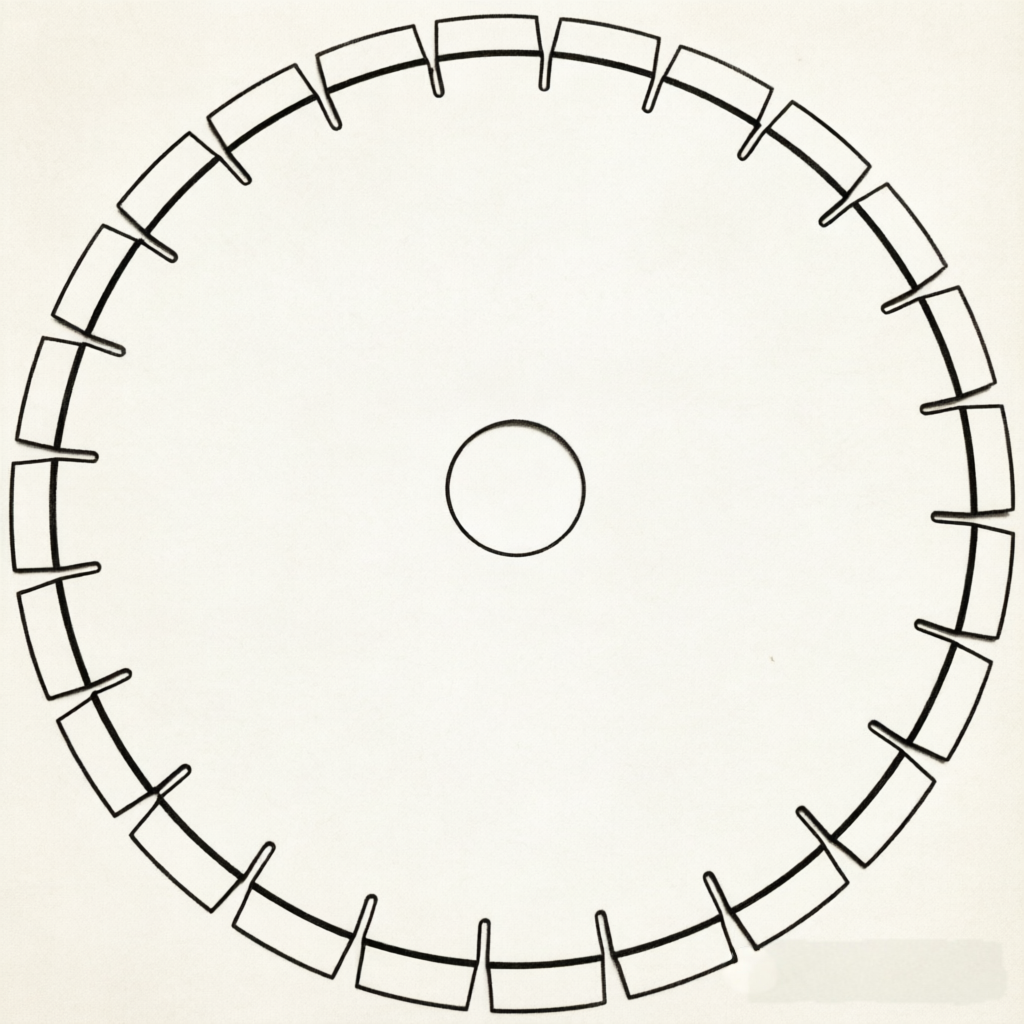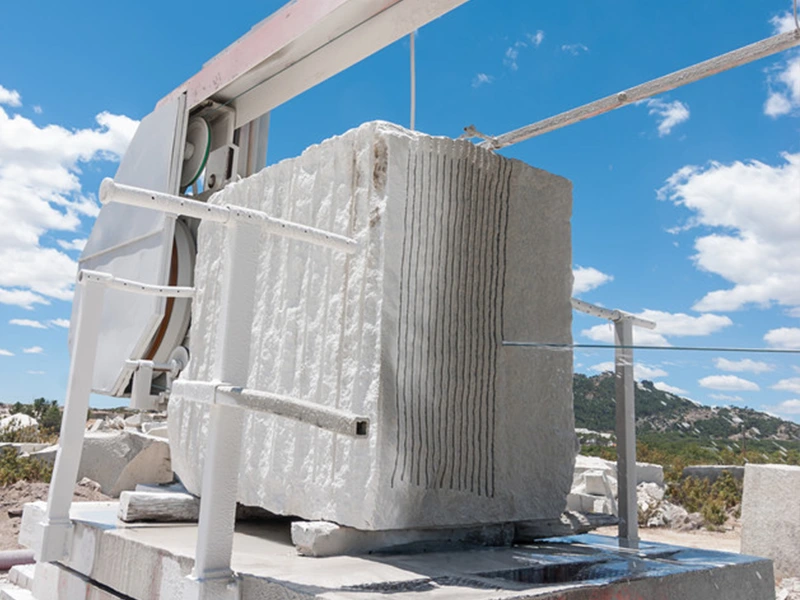

In the industry you will see several names for this technology — ordered segments, arrayed segments, arranged diamond segments, matrix-array segments, or by trade names used by various manufacturers (e.g. array-style placement technology). The principle is the same:
| Conventional (random) | Ordered (arrayed) |
|---|---|
| Crystals clump in some areas and leave empty zones. Crowded crystals chip or tear out early; bare zones cut nothing and generate heat. | Crystals sit at designed spacing, layer by layer. Every crystal has its own working zone, carries load and is exposed at a controlled rate. |
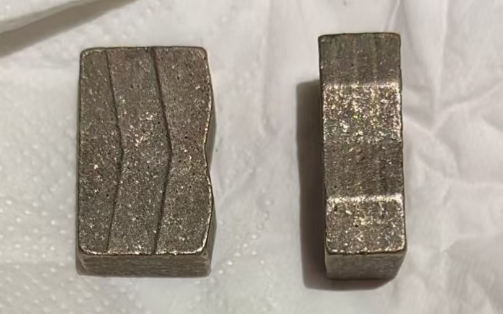
A diamond segment contains thousands of crystals, but in a conventional segment a large share of them never do useful work:
Ordered placement attacks all four. With controlled spacing, each crystal gets its own working zone and enough support; new layers are exposed at a designed rate as previous ones wear off. The practical result: the same, or even less, diamond does more cutting work.
Two broad approaches exist, and both add cost:
Both require positioning accuracy in the fraction-of-a-millimetre range, plus careful control of pressing pressure and sintering shrinkage so the array is not distorted. That precision is where the money goes.

| Cost driver | What changes | Effect on price |
|---|---|---|
| Placement step & cycle time | Extra process stage, lower throughput per press versus plain powder mixing | Largest single share of the premium |
| Higher-grade diamond | Placement only pays if the crystal survives long enough; weaker low-grade grit defeats the purpose | Raw material cost up meaningfully |
| Yield & rejection | Misplaced or shifted arrays must be scrapped; tighter tolerance means higher scrap rate | Recovered through unit price |
| Inspection & QC | Per-layer/pattern verification rather than simple weight and hardness checks | Added labour and equipment |
Note what is not usually the driver: marketing margin. The premium is manufacturing cost. Discount offers that claim "ordered" quality at conventional prices almost always mean lower diamond concentration or lower-grade grit somewhere else in the recipe.
Buyers care about four things. Ordered segments move all four, though the size of the gain depends on conditions:
Blade price is only one term, and often not the biggest one. Example — a 350 mm blade on reinforced concrete, one full working day:
| Item | Conventional segment | Ordered segment |
|---|---|---|
| Blade price | $60 | $80 (+33%) |
| Total metres cut | 900 m | 1,400 m |
| Cutting time | 9.0 h | 6.5 h |
| Machine + operator (US$45/h) | $405 | $293 |
| Blade changes (2 vs 1, 15 min each, US$45/h) | $22 | $11 |
| Total cost | $487 | $384 |
| Cost per metre | $0.54 | $0.27 |
The blade costing 33% more comes out roughly 50% cheaper per metre in this scenario. The reason is simple: on any job where a machine and an operator are already on site, cutting speed converts directly into saved hours, and hours are usually the dominant cost.
Reverse the same scenario — low daily volume, cheap labour, no time pressure — and the picture changes. See the matrix below.
| Situation | Recommendation | Why |
|---|---|---|
| High daily volume (>500 m/day per machine) | Ordered | Speed and life compound across volume; payback measured in days |
| Hard, dense, heavily reinforced concrete | Ordered | Each crystal carries real load, so placement efficiency matters most |
| High hourly cost markets (labour $30–60/h) | Ordered | Machine + labour dominate; speed is the cheapest variable to buy |
| Tight schedule / penalty clauses | Ordered | Consistent speed makes quotes predictable |
| Deep cuts, risk of core heat damage | Ordered | Lower localised heat protects core and bond |
| Low volume, occasional use (<50 m/month) | Conventional | Blade may age out before the premium pays back |
| Soft, highly abrasive material (asphalt, green concrete, block) | Conventional | Bond erosion sets wear rate; positioning buys little |
| Price-first tender, no quality weighting | Conventional | Specification will not let you win on TCO, only unit price |
| Operators skip break-in or adequate water | Conventional | Poor technique destroys ordered segments faster — fix practice first |
You can settle this in two minutes with your own numbers. Required extra life or speed to justify the premium:
Worked example: blade is 10% of total job cost, ordered blade costs 33% more → you need roughly a 3.3% improvement in output to break even. If blade share is only 3%, you need ~11% improvement. In either case that threshold is low — which is why ordered segments win on professional job sites and lose in low-utilisation use.
Track three numbers per blade for two weeks — blade cost, metres cut, machine hours — and the answer for your fleet becomes obvious. As a rule of thumb, the break-even point is usually crossed at a few hundred metres per day — run the numbers with your own rates to find yours.
In a conventional segment, diamond grit is randomly mixed into metal powder, so crystals clump in some spots and leave gaps in others. In an ordered or arrayed segment, each diamond is placed at a designed position with controlled spacing and orientation, so every crystal does measurable cutting work instead of being wasted.
Four cost drivers: precision placement equipment and slower production cycles, higher-grade diamond required to justify placement, stricter process control and higher rejection rates, and additional QC steps per segment.
Yes when volume is high, material is hard or heavily reinforced, or hourly machine and labor cost dominates the job. No when cutting volume is low, material is soft and highly abrasive, or the operator skips cooling and break-in — poor technique cancels the advantage.
Use cost per linear meter: total job cost divided by meters cut, where total cost = blade price + machine running cost + operator labor + downtime for blade changes. Blade price alone is a misleading comparison because the cheapest blade often has the highest cost per meter.
No. The advantage is largest on hard, dense, or reinforced materials where each diamond must carry real load. On very abrasive, soft materials like green concrete or asphalt, bond erosion rather than diamond positioning sets the wear rate, so the premium buys less.