
1. Where blade noise actually comes from
2. What a silent slot actually is
3. The three mechanisms: how damping works
4. Terminology across languages
6. Why this matters commercially
7. Design variables and their trade-offs
8. Common specification mistakes
9. How to specify a quiet blade correctly
10. Frequently asked questions
When a diamond saw blade is judged as noisy, the instinct is to blame the diamond segment or the bond. In most cases that is wrong. Segment noise is a small fraction of the total sound a blade generates.
There are three dominant noise sources, and only one of them is the cutting action:
1. Structural ringing of the core. A steel disc under rotation behaves like a bell. If the disc's natural frequency coincides with the excitation frequency from cutting, the blade enters resonance and amplifies sound dramatically. Resonance also produces the longitudinal "wobble" that produces uneven cuts.
2. Aerodynamic whistle at the rim. Air accelerated through the gullet between two passing segments generates a tonal, whistling sound. This is not a resonance — it is vortex shedding, and it can be remarkably annoying even at relatively low decibel levels.
3. Actual material removal. Diamond particles and bond abrading the workpiece. Real, but comparatively small in acoustic terms.
Noise reduction on a saw blade is not achieved by softening the diamond or changing the bond. It is achieved by treating the blade as a vibrating plate and a wind instrument — and addressing each with a different geometry.
This distinction matters commercially. A buyer who believes "quiet blade" means "gentler diamond" will specify wrongly, pay for the wrong product, and conclude the supplier was dishonest. Understanding that core geometry is the primary noise control lever is the whole point of this article.
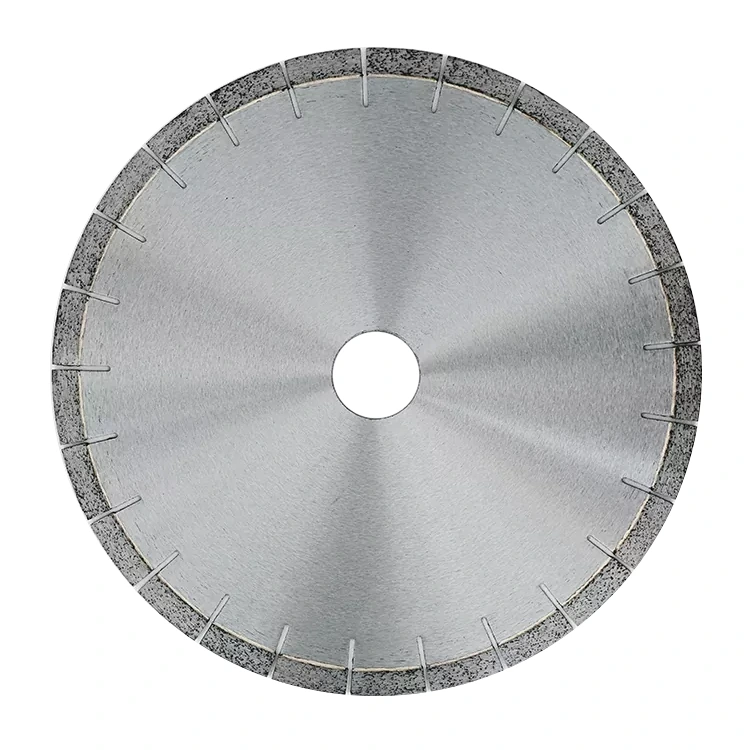
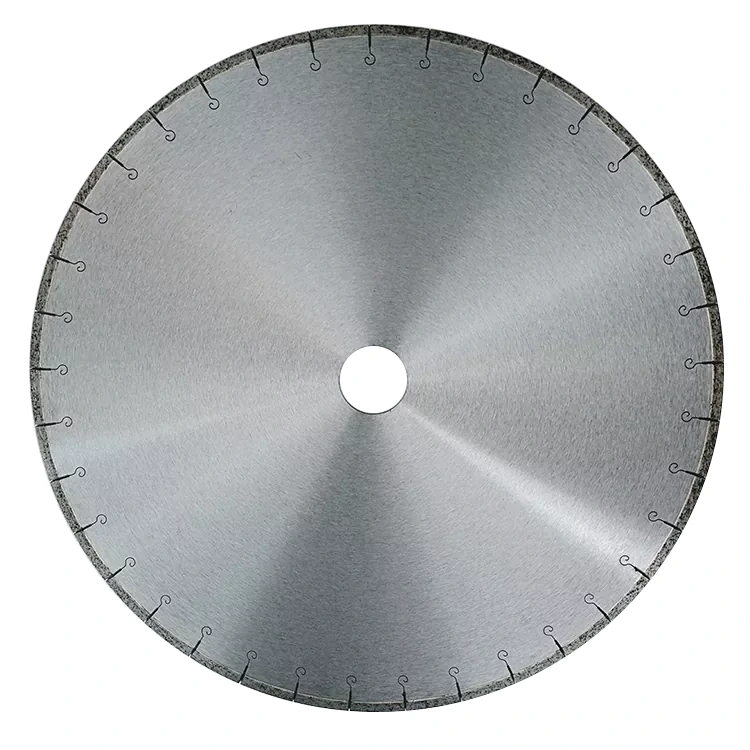
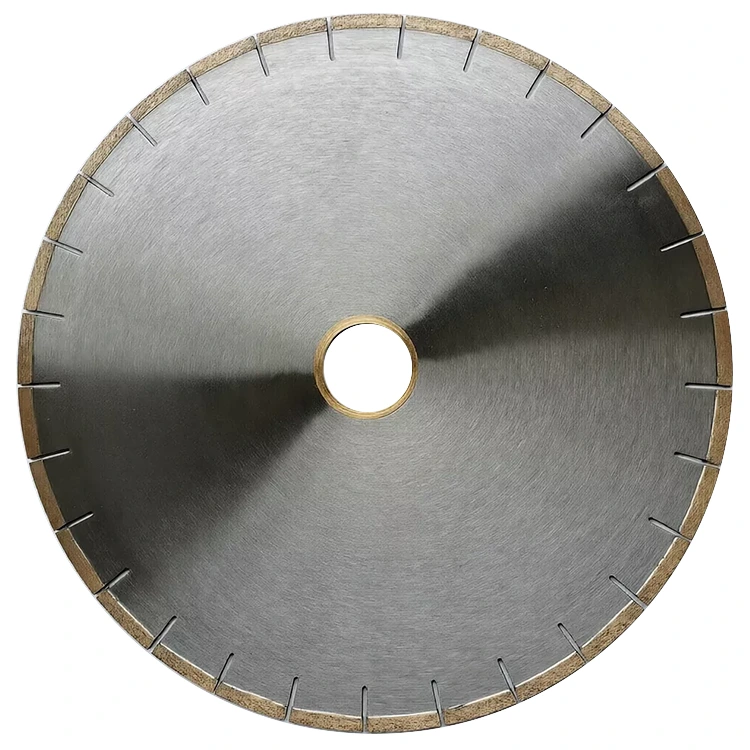
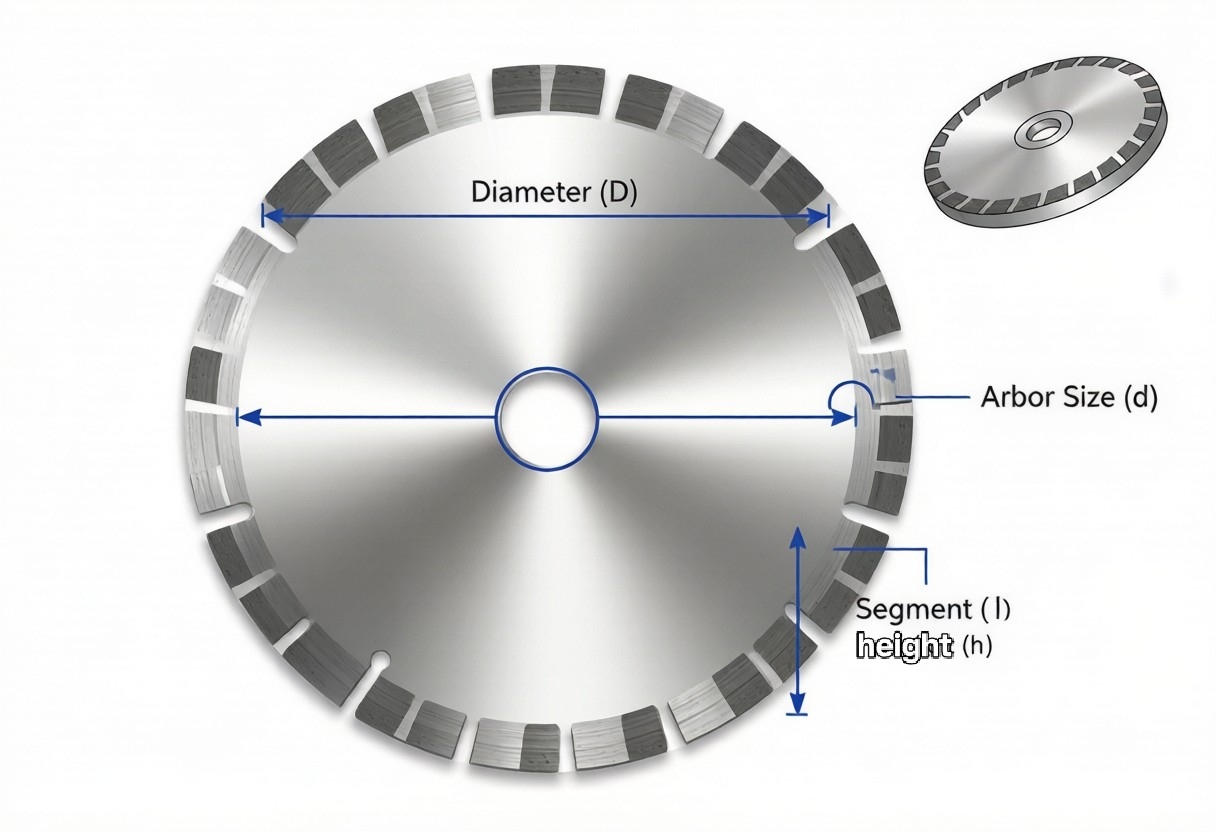
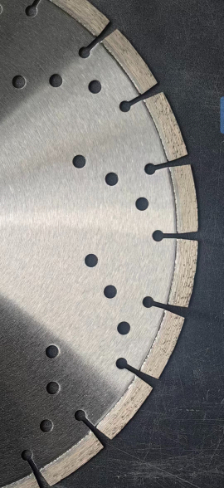
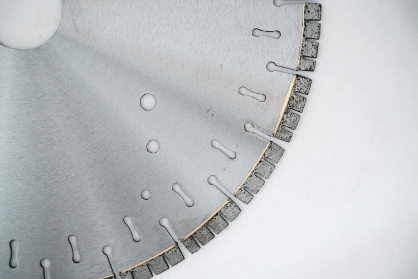
A silent slot — also written as anti-vibration slot, expansion slot, vibration damper slot, or damping slot — is a slot cut radially into the steel core of a diamond saw blade, stopping short of the centre bore.
It is not a hole, and it is not a cooling slot. The two are often confused, because both appear as gaps in the body of the blade.
Anti-vibration slot
Radial slot from the rim inward. Breaks up the core's resonant ring. The subject of this article.
Cooling slot
Slot allowing air or water to reach the cutting face. Primarily thermal management.
Expansion slot
Overlapping term; usually the same geometry as the anti-vibration slot, sometimes with different intent.
Gullet
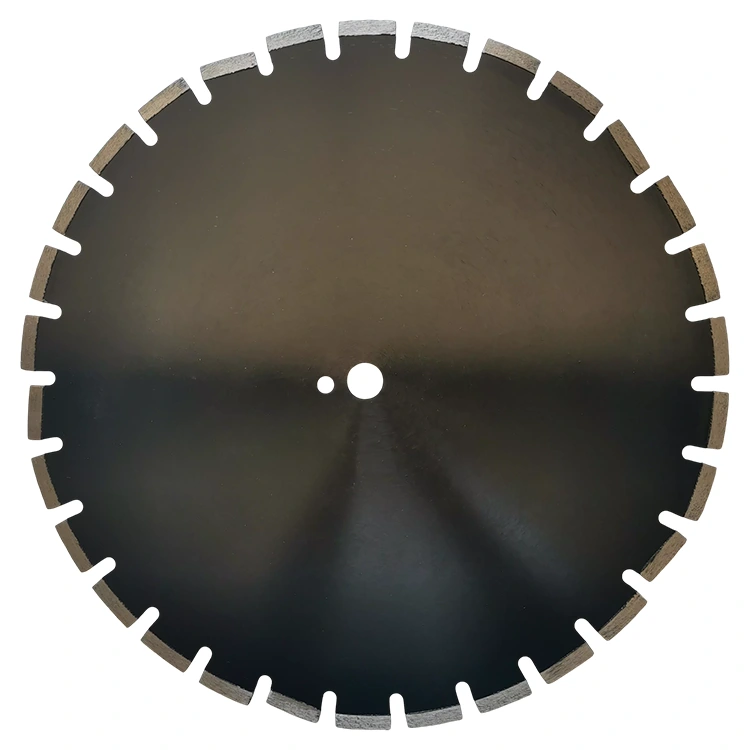
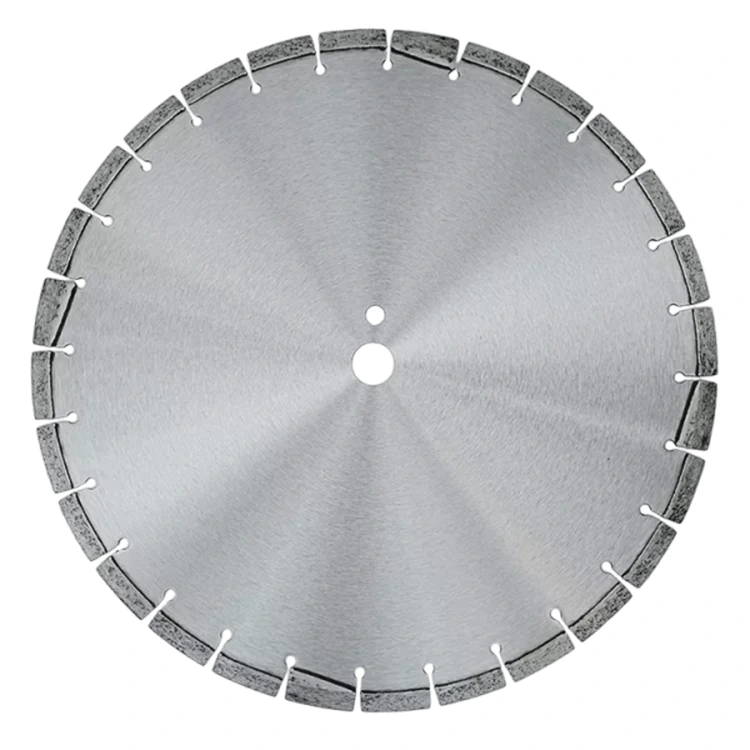
The gap between two adjacent segments. Debris clearance and airflow. Not a core slot.
Slot plug
Rubber or resin inserted into an anti-vibration slot to damp further.
Terms vary between manufacturers and across markets. What matters for a purchase specification is that you state the geometry and intent, not just the trade name your supplier happens to use.
Three distinct mechanisms are combined in a well-designed low-noise blade. They address different noise sources and are frequently conflated.
A plain steel disc is a continuous ring. Waves travelling around it reinforce each other, producing a strong standing wave and, at resonance, very high amplitude. A radial slot interrupts that path. The wave cannot propagate continuously around the circumference, so it is attenuated at each crossing.
This is the same principle as the slots cut into large flat metal panels to stop them ringing — a technique that predates diamond blades by decades. The slot is a mechanical discontinuity in an otherwise continuous vibrating structure.
An empty laser-cut slot already interrupts the ring. Filling it with a heat-resistant elastomer or resin adds a second layer of damping: the filling material is soft and lossy, so it dissipates vibration energy as heat rather than reflecting it back into the plate.
Documented practice from manufacturers of low-noise concrete blades includes laser-cut core slots filled with heat-resistant rubber inserts, combined with reduced core and segment thickness to lower the vibrating contact area. The thinner the core relative to the disc diameter, the less material there is to ring — which is why battery-rated low-noise blades frequently specify a "super thin" core.
Noise scales strongly with the mass of the vibrating element. A "super thin" core does two things at once: it reduces the vibrating surface that radiates sound, and it lowers the rotational inertia the motor must overcome. This is why premium battery-oriented blades specify 13 mm conical segments on a thin core rather than a thick slab segment on a heavy disc.
This is the mechanism buyers most often miss, and it is a different phenomenon from A and B.
Gullets are normally spaced symmetrically around the rim. When segments pass at regular intervals, the airflow through each gullet is interrupted at a regular frequency, producing tonal acoustic emission — a whistle. Vortex shedding from a symmetric gullet arrangement is exactly analogous to the note produced by blowing across the fipple of an organ pipe, and equally regular.
The fix, patented by Norton in its Silencio product line as "off-set gullets", is to alternate the gullet spacing so that no single frequency repeats. Instead of a periodic whistle at one dominant pitch, the airflow noise is spread into broadband, low-level noise that is far less objectionable and far less fatiguing.
It is worth noting what this is not: it is not a reduction in sound power by the same mechanism as a sandwich core. It is a change in the spectral distribution of the noise. Engineers describe the result as "reducing whistling air flow around the blade" rather than claiming a decibel figure.
Be precise about what any supplier is claiming. These are three different, non-interchangeable statements:
· "Sound power reduced by X dB(A)" — a measurable, standardised claim. Requires the measurement method to be stated.
· "Vibration reduced" — different units entirely (m/s²), measured per ISO 5349 or ISO 10816.
· "Whistling eliminated" — a spectral characterisation, not a dB value, and cannot be converted into one without data.
Specification errors cluster around translation. The same slot is called different things in different markets, and a buyer who searches in the wrong term may conclude a supplier's product does not exist.
|
Term used in practice |
What it denotes |
中文 equivalent |
|
Anti-vibration slot |
Radial core slot breaking resonance; may be empty or filled |
减振槽 / 抑振槽 |
|
Silent slot |
Marketing term for the same feature; no standardised definition |
静音槽 |
|
Expansion slot |
Same geometry, often framed as thermal expansion allowance |
膨胀槽 |
|
Damping slot |
Emphasises energy dissipation rather than resonance break-up |
阻尼槽 |
|
Gullet |
Gap between adjacent segments; clearance and airflow |
排屑槽 / 刀齿间槽 |
|
Segment |
The brazed or laser-welded unit carrying diamond |
刀头 / 节块 |
|
Core |
The steel disc body; carries the segments |
钢芯 / 基体 |
|
Bond |
Metal matrix holding diamond particles in the segment |
胎体 / 金属结合剂 |
|
Laser weld |
Fusion joint attaching segment to core |
激光焊接 |
|
Sintered diamond |
Compact formed under heat and pressure, no metal matrix |
烧结金刚石 |
A buyer who writes "we need a silenced blade" and expects a supplier to supply a low-noise product will sometimes receive a product with a different characteristic entirely — typically one intended for dry cutting, where heat dissipation drives the slot design. Always specify the geometry and the measurement, not a marketing adjective.
Measured performance of low-noise blades varies by construction. The two main families are:
|
Construction |
Reported noise reduction |
Trade-off |
|
Multi-layer sandwich core |
Documented manufacturer claims of up to −15 dB(A), described as approximately 30 times less noise than a conventional blade |
Heavier and more expensive; typically requires continuous coolant to protect the interlayer bond |
|
Laser-slotted core, optionally rubber-filled |
Documented manufacturer claims around 12 dB reduction for battery-rated concrete blades |
Lighter, lower cost, no coolant requirement; less total attenuation than a sandwich core |
A 15 dB and a 12 dB reduction are not measured on the same basis, and neither figure is comparable without knowing the reference condition, the material being cut, and whether a saw or a machine was the sound source. Because the decibel scale is logarithmic, a 12 dB reduction corresponds to roughly a 75% reduction in sound energy — perceptually a very large change to an operator, and not something to be dismissed as marginal.
For procurement purposes, the honest position is this: request the supplier's test basis. Which standard, which material, which machine, what reference condition. A supplier unwilling to state that has probably measured at the factory gate on a bench with no workpiece, which is close to meaningless.
Noise is not a comfort preference. It is a regulated exposure, and the regulations are specific.
|
Jurisdiction |
Reference |
Threshold |
|
European Union |
Directive 2003/10/EC — Noise |
Lower action value 80 dB(A) LEX,8h |
|
United Kingdom |
Control of Noise at Work Regulations 2005 |
Aligned with the EU values: 80 / 85 / 87 dB(A) |
|
Germany |
LärmVibrationsArbSchV |
Transposes Directive 2003/10/EC into national law |
|
China |
GB 12523-2011 — Construction site boundary emission |
70 dB(A) daytime |
|
Australia |
Safe Work Australia Model WHS Regulations |
85 dB(A) average over 8 h |
|
Canada |
CCOHS Occupational Health and Safety Regulations |
87 dB(A) exposure limit |
|
Japan |
Noise Regulation Law |
85 dB(A) average |
|
United States |
OSHA / NIOSH |
OSHA enforceable limit 90 dBA (5 dB exchange rate); NIOSH recommends 85 dBA (3 dB exchange rate) |
First — worker exposure vs site boundary. Occupational limits (EU Directive 2003/10/EC, OSHA) govern what a worker receives over a shift. Boundary limits such as China's GB 12523-2011 govern what reaches neighbours. These are different regimes with different numbers. Quoting an occupational figure to answer a community noise question is a category error, and vice versa.
Second — action values vs limit values. In the EU framework, the exposure limit value of 87 dB(A) accounts for the attenuation of hearing protection, while the action values do not. Crossing an action value triggers duties — protection provision, training, health surveillance — rather than constituting a breach. Many low-noise blades keep a hand-held operation comfortably below the 85 dB(A) upper action value, which removes the mandatory-hearing-protection obligation and the associated programme cost entirely.
Noise reduction is not primarily an environmental goodwill measure. It is a schedule and compliance cost:
· Urban sites. Many municipal permits restrict noisy work above a stated boundary level to weekday daytime hours, with Sundays and public holidays excluded absent a special permit. A blade that keeps the job below the threshold converts a night-shift premium into normal working hours.
· Occupied buildings. Hospitals, schools and live offices frequently prohibit noisy work during operating hours. A quieter blade allows cutting to continue during normal hours inside the building — directly reducing labour cost and programme duration.
· Tender scoring. For public hospital, school and municipal contracts, demonstrable acoustic performance is increasingly a scored criterion rather than a nice-to-have. Specified dB figures give a measurable bid answer.
This is why the quiet blade question is worth asking at specification stage rather than after the first complaint. The difference between a compliant and non-compliant blade is frequently measured in shifts, not in decibels.
Noise reduction is one variable among several, and each choice costs something else. This is the design space a manufacturer actually works in.
|
Variable |
Effect on noise |
Trade-off against |
|
Core thickness |
Thinner core = less vibrating mass = lower sound radiation |
Sidewall strength, segment retention under load |
|
Number of anti-vibration slots |
More slots = more interruptions of the resonant path |
Core strength; excessive slotting can weaken the disc |
|
Slot depth (radial) |
Deeper slot breaks the ring more effectively |
Must remain clear of the bore and the arbor region |
|
Slot fill material |
Rubber or resin adds lossy damping beyond the air gap |
Heat resistance; requires adequate thermal margin |
|
Gullet spacing pattern |
Off-set / alternating spacing spreads tonal noise to broadband |
Segment count, segment shape, cutting behaviour |
|
Segment height |
Lower profile reduces material engaged at any instant |
Cutting depth capability and blade life |
|
Segment shape (turbo wave) |
Serrated profile continuously exposes fresh diamond |
Finish quality; not suitable for polished edges |
|
Bond hardness |
Harder bond = less matrix wear = potentially less vibration |
Abrasive materials glaze the segment faster |
|
Core balance quality |
A true-running disc avoids one source of periodic excitation |
Manufacturing cost; requires balancing equipment |
Every mechanism that reduces noise does so by removing or decoupling vibrating material. This is not free: a thinner core, shallower segments or more extensive slotting all reduce the blade's capacity to absorb heat and shock. A blade optimised for minimum noise will generally not be the blade with the longest service life on abrasive work. Specify for the job, not for the lowest number.
These recur regularly in purchase enquiries, and each one produces a disappointing outcome.
1. "Supply a silent blade." No geometry, no material, no measurable target. Unsupplierable and unverifiable.Write: "Core to include laser-cut anti-vibration slots with heat-resistant elastomer fill. State slot count, radial depth and fill compound on the datasheet."
2. "Noise level shall not exceed 85 dB(A)." Ambiguous: sound power or sound pressure? At the operator's ear or at the boundary? At what distance?Write: "Sound pressure level at operator position, LpA, dB re 1 N/m², measured per EN ISO 11201, material and machine stated."
3. Requiring a sandwich core without stating coolant. Multi-layer cores commonly require continuous coolant to protect the interlayer. Dry use may void the acoustic benefit and damage the blade.Write: "Wet cutting only" in the application limits, per the marking required by EN 13236.
4. Requiring maximum noise reduction for abrasive work. On high-abrasion concrete, an aggressive thin-section blade wears faster than a standard one. Cost per metre cut rises even if decibels fall.Write: "Low-noise construction for urban or occupied-site work" and specify the material class it will cut.
5. Accepting a dB claim with no test basis. "Up to 15 dB reduction" means nothing without the reference condition. The "up to" is usually a best case.Write: "State measurement standard, workpiece material and reference condition for any acoustic claim."
The phrase "up to X dB reduction" is not a specification. It describes a best case under conditions the supplier chose. Ask for the condition. A supplier who can state their measurement basis confidently is a supplier who has actually tested. One who cannot is repeating a number from a competitor's brochure.
A workable purchase specification, in the order the questions should be asked:
1. Application first. Urban site, occupied building, or open ground? This determines whether noise reduction is a regulatory requirement or an operational benefit.
2. Material second. Reinforced concrete, brick, asphalt, natural stone or engineered stone. Abrasivity governs the life/noise trade-off.
3. Machine third. Hand-held saw, walk-behind saw or table saw. Sound power and the applicable EU framework (2000/14/EC for outdoor equipment, 2006/42/EC for declaration of noise values) both depend on this.
4. Construction fourth. Sandwich core or laser-slotted core? Does coolant exist on site?
5. Geometry fifth. Slot count, radial depth, fill material, gullet spacing pattern, segment height, core thickness.
6. Marking sixth. Whatever the application, the blade and packaging must carry the EN 13236 marking set — including maximum operating speed, direction of rotation, application restrictions (wet only where applicable), manufacturer identity, supplier name, and a traceability code. The traceability code is the element that matters most if a claim is ever filed.
Among the EN 13236 marking requirements, the traceability code is what connects a failed blade back to a production batch. Without it, a distributor cannot substantiate a warranty claim, and a supplier cannot investigate a root cause. This becomes concrete in practice: if a blade fails in service, the ability to identify which heat treatment lot it came from is what determines whether the issue is contained or repeats across a year of production.
Do silent slots reduce cutting speed?
Not inherently. Slot geometry affects resonance and airflow, not abrasive cutting rate, which is governed by diamond grade, concentration, bond hardness and segment height. However, if a low-noise design also requires lower segment height or a thinner core to achieve the acoustic target, some speed and life reduction follows indirectly. Ask separately about the acoustic specification and the cutting specification.
Can I retrofit silent slots to an existing blade?
No. The slots are laser-cut into the steel core before segments are welded to it. Retrofitting is not possible, and drilling or cutting a working blade is dangerous — it destroys the balance and the residual tension in the disc. Replace the blade.
Are wider gullets quieter?
Not inherently. Gullets primarily control debris clearance and cooling. Their effect on noise depends on the spacing pattern rather than the width. The whistle mechanism described above is about periodicity, so an alternating or off-set arrangement matters more than width for tonal noise.
What is the difference between sound power and sound pressure?
Sound power (LWA, dB) is the total acoustic energy the machine radiates — a property of the machine. Sound pressure (LpA, dB) is what arrives at a listener's ear, and depends on both the machine and the distance. For site noise assessment, sound pressure at the boundary is what regulations reference. For operator exposure assessment, sound pressure at the operator position is used. Never compare a figure in one unit against a limit expressed in the other.
Does a quieter blade last longer?
Not automatically, and often the opposite. Every damping mechanism removes or decouples vibrating material, which reduces the blade's capacity to absorb heat and shock. A noise-optimised blade is usually a compromise. Expect a quiet blade suited to urban or occupied-site work to have a somewhat shorter service life than an aggressive standard blade on the same abrasive material.
Is there a standard for marking quiet blades?
EN 13236 covers safety requirements and marking for superabrasive products including diamond cutting wheels. It does not define a "silent" class or require a noise figure to be marked. Acoustic claims are, at present, commercial specifications rather than a standardised standard category. State the requirement in the purchase order if it matters to you.